THE SCANDINAVIAN TEXTILE INITIATIVE FOR CLIMATE ACTION (STICA)

Progress Report 2025

THE SCANDINAVIAN TEXTILE INITIATIVE FOR CLIMATE ACTION (STICA)

Progress Report 2025

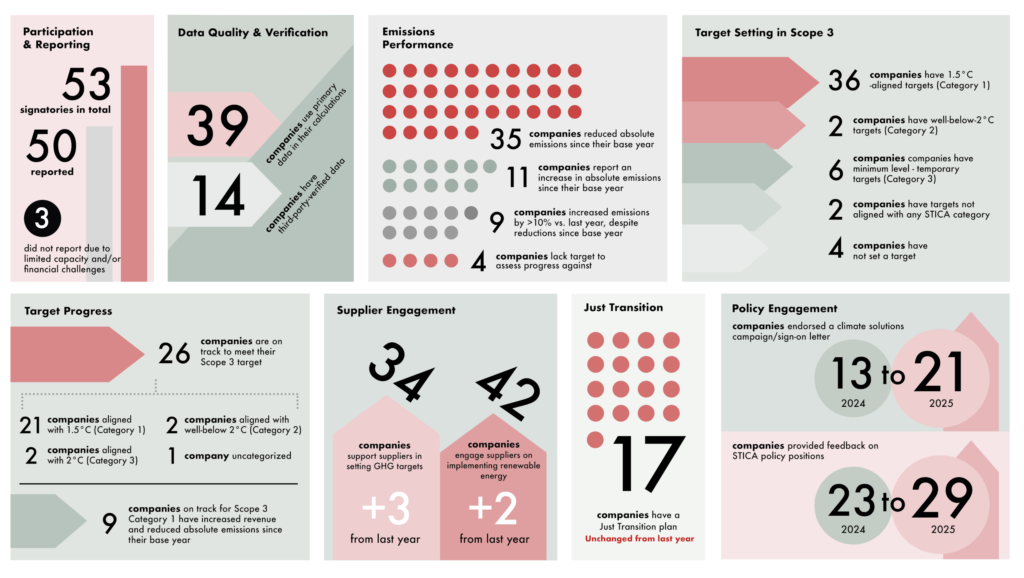
Selected Highlights

STICA’s Company Climate Action Program 2025 Progress Report presents individual company disclosures and aggregate data on the progress of signatory members’ Climate Action Transition Plans, based on emissions data from their most recent financial year. It also provides an analysis and general conclusions drawn by the Sustainable Fashion Academy (SFA).

For addional assets, please view the Press Material section.

Report Conclusions

Based on the data in this report, SFA concludes the following:

This data has its strengths and weaknesses. To ensure more reliable and accurate reporting, supply chain traceability, transparency, and data quality need to be significantly improved. Moving forward STICA will require that signatories continually increase the percentage of primary data they use when doing future calculations.


Many company signatories participating in STICA’s Climate Action Program have come a long way in a relatively short time. It can also take time for climate actions and investments to yield results.

The progress of a significant number of STICA signatory members continues to be too slow. Companies have reported a number of challenges they are facing and suggested solutions, many of which require government action.

Shareholder and owner demands for short-term financial growth and the lack of sufficient financial incentives continue to make absolute GHG emissions reductions challenging. That being said, there are positive developments in a number of countries where apparel products are manufactured. Progress is possible, even if it is too slow for what the scientific community says is needed to remain on the 1.5°C warming pathway.

The move in the EU to rollback sustainability reporting legislation is not helping. STICA signatories want simplified legislation but not diluted legislation. The impending changes mean most STICA companies will now be out of scope.This is not welcome, especially given the lack of financial incentives for climate action. Smarter legislation is needed to ensure there are sufficient financial penalties for not reducing emissions and commensurate rewards for reducing emissions and transforming business models.

It is essential that stakeholders explore additional and/or different success indicators for the industry based on concepts such as well-being and sufficiency.

Michael Schragger, Initiative Co-founder & Director, STICA

“The progress of STICA signatories, though gradual, shows that companies have no excuse not to act on climate. But to ensure these actions align with science, address the climate risks facing apparel workers, and build resilient supply chains, policymakers must remove barriers and make climate action a true driver of innovation and industry transformation.”

Signatory Spotlight

This section highlights companies that, according to their reporting to STICA and our subsequent analysis, are currently on track to meet key climate performance criteria. These companies have made progress toward their 1.5°C-aligned Scope 3 Category 1 targets, increased revenue since their base year, and reduced absolute emissions over the same period.

Marielle Krus, Sustainability Manager, Bubbleroom
Sandra Roos, Vice President Sustainability, Kappahl​
Eliina Brinkberg, Climate & Environmental Manager, Nudie Jeans​
Maria Schartau, Sustainability Manager Snickers Workwear & Solid Gear, Hultafors Group​
Titti Larsén, Quality & Sustainability Manager, Stadium​

Stakeholder Voices

We asked representatives from a selected group of stakeholders for their perspectives on the 2025 Report content, suggestions on what could be improved, as well as their view on what implications the report has for climate action in the apparel industry.

Ruth MacGilp, Fashion Campaign Manager, Action Speaks Louder​
Peter Ford, Energy Policy Lead, EnergyLab Asia​
Lars Fogh Mortensen, Circular Economy, Consumption & Production Expert, European Environment Agency (EEA)
Dr. Katy Stevens, Head of CSR and Sustainability, European Outdoor Group (EOG)
Anette Andersson, Sr. Sustainability Investment Specialist, Skandinaviska Enskilda Banken (SEB)​
Anna-Karin Sundelius, Senior Policy Advisor for Textiles, Swedish Society for Nature Conservation (SSNC)​
Elin Larsson, Director of Market & Finance, WWF Sweden

Press Material

MIchael Schragger, Initiative Co-Founder & Director, STICA

For further inquiries, please contact nina@sustainablefashionacademy.org.